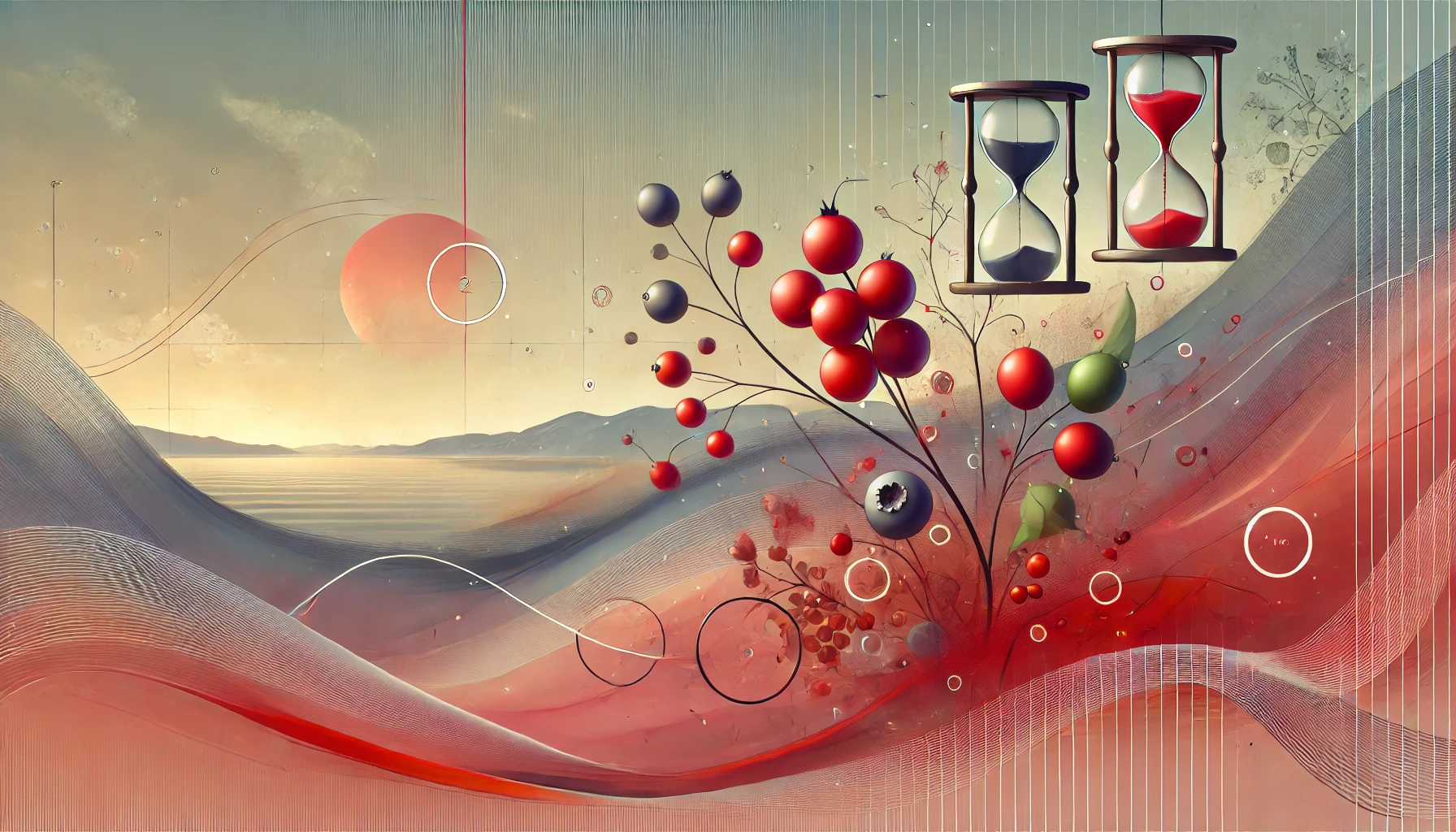

“The unfortunate truth is that most of the important issues in life are more complex than the choices immediately preceding them”
We are naturally predisposed to be curious about the impact of our actions, and there is clearly a biological and evolutionary basis for this.
If I eat a certain type of berry and proceed to throw up, I should be able to draw a reasonable conclusion that this type of berry causes me unpleasant gastrointestinal consequences, and it might behoove me to avoid it in the future.
This feedback cycle is what allows us to learn, becoming more effective and competitive, even in a modern world where most berries are now store-bought.
Being able to recognize that a certain type of tone with my boss leads to getting promoted, while a different tone leads to me getting fired is a useful piece of information as I move on with my life. Because, generally speaking, I would like to avoid getting fired and earn more promotions.
And so we learn. We act in a certain way, observe the results, formalize a relationship between our action and the results, then update our behavioral model and proceed.
This ability to learn is one of the incredible advantages available to people, and is part of what makes us such a competitive species.
But—there are times where our learning falls short, particularly in areas where the outcome is temporally separated from the action. Essentially, we have a hard time internalizing that sometimes results take time, and that certain outcomes are explained by long-past actions.
One of the most obvious iterations of this issue can be found in politics.
How often have you heard the phrase “I felt more economically secure during (insert name here)’s term”?
This is absolutely learning. There was some type of action/change—in this case an election—and we observe the changes in our outcome, arriving at the conclusion that our economic security has changed. It is a perfectly rational form of learning by the systems and standards described above.
But it also happens to miss the point. Because our learning model necessitates the ability to formalize the relationship between action and outcome. Specifically, a good learning model necessitates forming an accurate relationship between action and outcome.
In politics and economics, there are time lags. A policy implemented in Year X might not yield any noticeable benefit until Year X+5. Similarly, mistakes made in a given year may not materialize until years down the road. This is because it takes time for businesses and regulations to respond, and people are often slow to adapt.
The economics observed at a given point in time are hardly a result of the economic policy at that given point in time—they are a product of years and decades of economic policies which have led us to that point in time.
And so, the relationship that we formalize in our mind is simply not an accurate representation of reality.
Time lags exist outside the scope of just the economy. Environmental policy changes take decades to accrue, physical fitness doesn’t come and go overnight, and relationships are rarely built or destroyed in a day.
The unfortunate truth is that most of the important issues in life are more complex than the choices immediately preceding them. And as such, it’s important to recognize that our learning machinery, while incredibly powerful for certain circumstances and analyses, leaves something to be desired for more nuanced issues.
That’s not to say we shouldn’t trust our ability to learn or value our own experiences—it’s simply a recognition that every once in a while, maybe it wasn’t the berry that made you sick.
Leave a Reply