
“Risk starts to matter more when you’ve built something worth protecting.”
On the precipice of a transition to Boston for a new job and a new metaphorical lease on life (as well as a quite literal lease in the West End), I found myself engaging in the timeless tradition of flipping through memories—experiences, adventures, decisions—that had brought me to this particular juncture in space and time, compared to the infinite possibilities that may otherwise have been.
And not to toot my own horn, but I’ve had my share of adventures—hitchhiking in New Zealand, farming in Ireland, running wilderness crews in the Nevada desert. Some good times.
But in this particular stroll down memory lane, I found myself latching onto an adventure I had not undertaken.
To set the scene: I had just wrapped up a stint farming on Whidbey Island in Washington State and was in my full crunchy-granola phase (pictures have since been burned, and hard drives erased). I was set to begin college in three months, and had an itch for “one big, last hurrah,” as I put it. It was abundantly clear to me at the time that once I settled into my dull college existence, the rest of life would go by in a whirlwind of nothingness and met expectations.
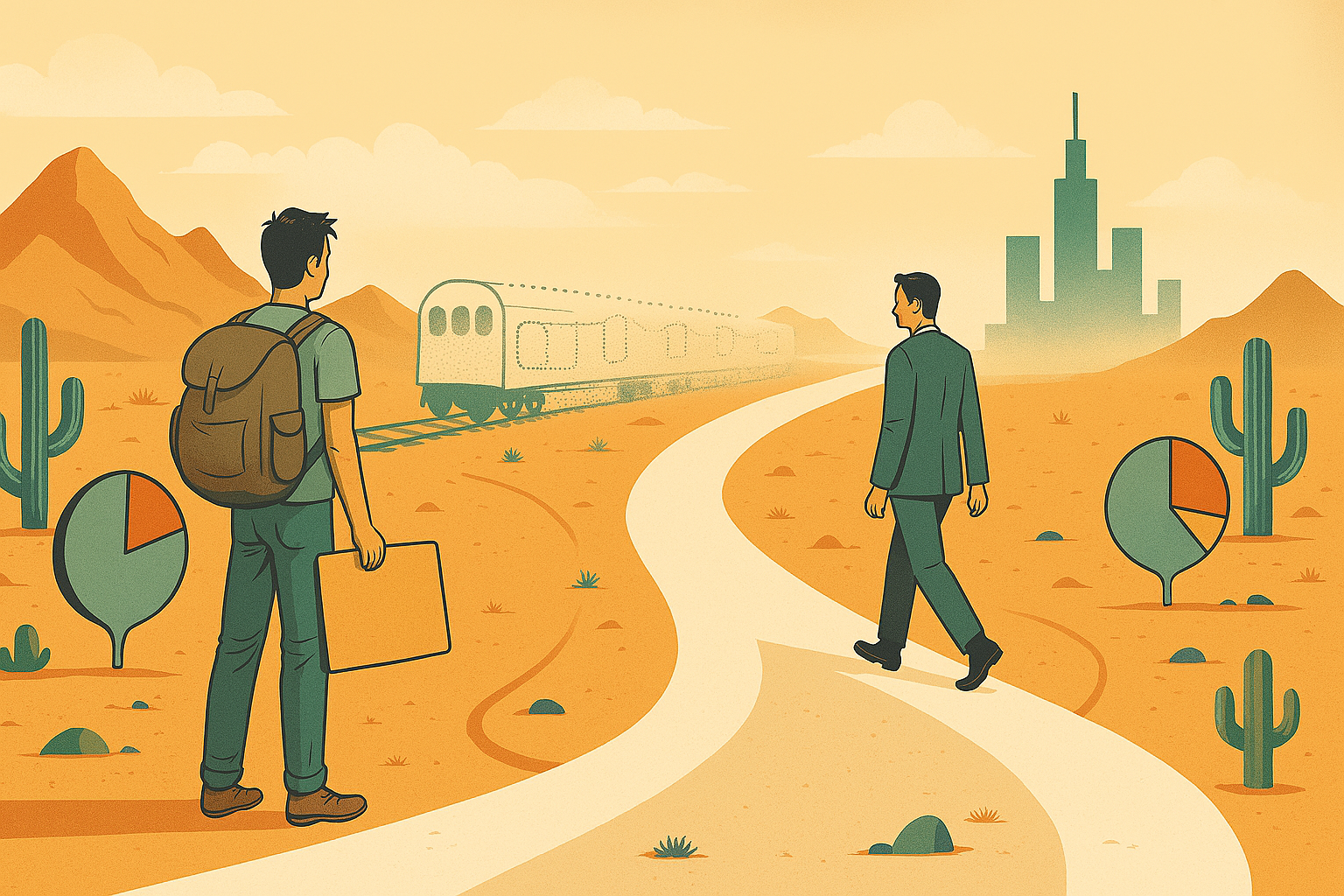
This was when I had the brilliant idea to embrace an age-old American tradition—hopping freight trains.
I started putting the pieces together—looking at routes, trying to understand the well-guarded tradition of slipping into a railroad car in the dead of night. A determined young renegade on a quest to feel alive. The plan was to travel East to West and see if I could make it all the way across the country, running into the cold Pacific at the end of my journey.
I’ll stop the fantasy here, as I don’t mean to steal valour from an imaginary self. I never ended up going on this trip, for a number of reasons—including the at-best dubious legality of such a pursuit.
Instead, I attempted the slightly more socially sanctioned version—hitchhiking—before an unpleasant 24-hour stint at a highway overpass led me to trade the endeavor in for a good old-fashioned Greyhound.
But these adventures are neither here nor there—at least as far as my point is concerned.
What stuck with me was the thought I had when revisiting that aborted railroad adventure: There’s no way I would try that today. But what didn’t come up was, What was I thinking? or How could I have done that? That voice never showed up.
I didn’t judge my younger self. I understood him—why he thought that way, why he made the decisions he did.
Some will say that’s just maturity. Perspective, experience, a few more neural pathways. And they’ll say that even if I understand those past decisions now, it doesn’t mean they still reflect who I am.
They’d be right.
But as an economist, I can never leave well enough alone (I was taught this in micro-theory). So I’ll posit another hypothesis. It may not be correct—but then again, economic hypotheses rarely are. (I was taught that in macro.)
Twenty-one-year-old me was a smart, capable, hard-working guy.
But—he had little in his bank account, no immediate prospects, and frankly, could’ve used a shower. A great guy—a talented guy, for sure. But one with a terrific life? One who had worked hard to build a world that was comfortable and well-suited for him? Who looked forward to waking up in the morning, felt like his day-to-day was pretty good, and believed that his day-to-day next year would be even better?
I don’t think that was the case. And not in a boo-hoo kind of way—more in the way I imagine it is for most young people.
When you’re young, you don’t really know yourself. What you like. How you work. What’s good for you.
Maybe you’re privileged, and you’ve had opportunities handed to you—so you’ve never had enough challenge to figure out what meaning is. Maybe life’s been hard, and you haven’t had much handed to you at all—and you’ve fought for every step you’ve gained.
Regardless of the individual story, the story that many young people share is one that hopes for a better tomorrow—a future where they get to make their own decisions, and reap the benefits of all the things they’ve had the chance to build.
Maybe young me wasn’t just a neurally underdeveloped hippie in need of a shower. Maybe he just didn’t have as much going for him as the person I am now.
And maybe the shift that happened wasn’t about fear, or caution. Maybe it was about value. Risk starts to matter more when you’ve built something worth protecting.
As with most theories we posit in economics—good luck figuring out if it holds any water. But like most of those theories, it gives us a way to think about the world, and how we move through it. Maybe even in a way that leaves us a little more grateful. A little more full of grace, at the end of a long day.


Leave a Reply