

“A trade-off happens at any given moment, but after that, the world changes”
‘Zero-sum’ is a term people love to throw around these days. My personal theory is that this is because it sounds incredibly cool – whenever I say it, I feel like I’m in some critical meeting, discussing the fate of the world and profit, all hinging on my brilliant insight and steadfast decision-making.
But aside from having a cool name, zero-sum games have a very specific definition:
A zero-sum game is one in which a win for one player must be mirrored as a loss for another.
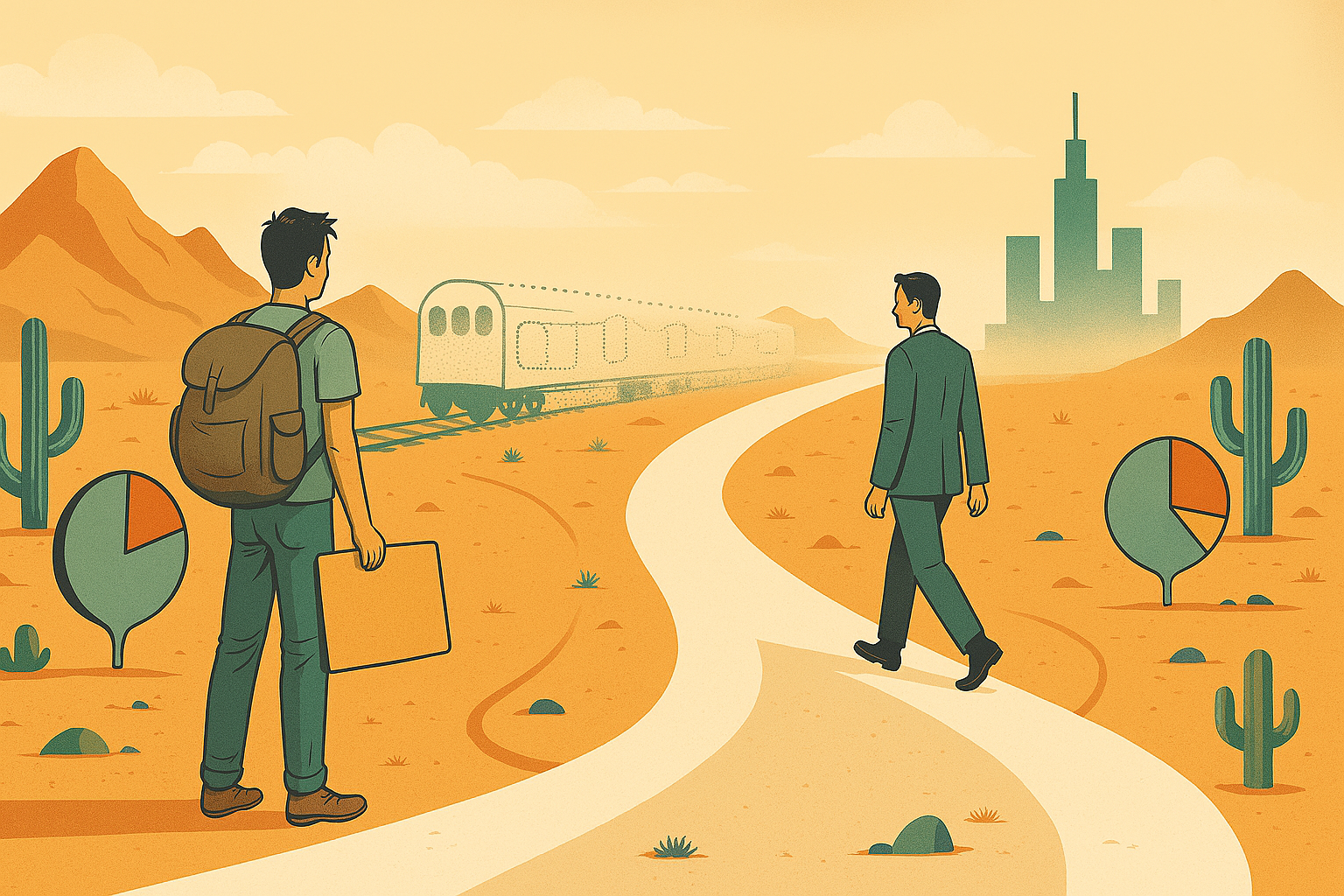
Think about it like dividing up a pie.
Say you and I agree to split a pie 50-50. From this point forward, there’s no way for me to gain an additional piece of pie without causing a mirrored reduction in the size of your piece. My gain will be exactly your loss, and vice versa.
This is true because the total prize – the thing of value – is constrained in size. There’s only so much pie, and if I’m getting more of it, you must be getting exactly less, by definition.
That’s the essence of a zero-sum game.
But pies are a bit removed from most people’s day-to-day reality, so let’s focus on something else which is constrained: time.
We all have the same 24 hours in a day. Imagine a person divides their 24 hours like this:
- 8 hours sleep
- 8 hours work
- 8 hours family time
The use of time in this instance can also be seen as a zero-sum game. There’s no way for any one of these categories to change without impacting the others. If I want to spend an extra hour working, that hour needs to come from somewhere – I can sleep less, spend less time with my family, or some combination of the two. But there must, by definition, be a mirror impact.
As such, it would seem that almost any decision we make can be framed in a zero-sum manner, because there’s always going to be an opportunity cost. We could debate whether the trade-offs are identical and the sum is exactly zero, but technicalities aside, this is a certain way of looking at and approaching the world.
But it’s limited, for the simple reason that it constrains itself to a momentary snapshot.
For example, it’s absolutely true that if I want to spend an extra hour working, that hour must come from somewhere – this is a short-term, zero-sum trade-off.
But what if I take that hour and spend it writing a program that automates some of my work tasks, so that I can achieve the same productivity in 7 hours instead of 8? Assuming I care about productivity rather than hours I sit in front of a screen (which is reasonable), I’ve actually managed to “create” another hour.
Yes, there was an initial zero-sum decision. But moving forward, the constraints have changed – the sum is no longer zero.
Suddenly, the short-term loss results in a long-term overall gain.
We’re growing the pie, if you will.
The point here isn’t that zero-sum games aren’t real or prevalent. It’s merely that they are incredibly short-term. A trade-off happens at any given moment, but after that, the world changes.
In game theory, we’d say that the payoff matrix is altered.
In negotiations, we’d say that integrative solutions become available.
It’s all different flavors of the same thing – the world isn’t static.
Although trade-offs may be zero-sum in the short term, the moment the horizon moves further out, the trade-offs rarely remain so simple.
Why is this important? Because when we think in a zero-sum manner, we think in black and white. Wins and losses. Us and them. And the point I’m trying to make is that this type of thinking is short-sighted. Although there may be a short-term, zero-sum game at play, there’s almost always going to be a long-term, integrative game at play as well.
By recognizing that zero-sum is almost entirely a short-run phenomenon, we can help ourselves snap out of the distributive way of thinking and focus instead on optimizing for the long term.
Because after all, if everybody can have more pie, why wouldn’t we want that?

Leave a Reply